
Nairobi’s Floodgates

On what we actually want, what the county actually did and the Singapore dream as tragedy
What is the rarest thing in Kenyan public discourse?
Members of the educated class indicting ourselves in public without being asked to. The people we have collectively decided are the custodians of the nation's future, whose hands we place the fate of the country we love, professionals who spend their working lives making critical decisions with such longstanding consequences.
Election Answer
We have a habit, in this country, of treating elections as aberrations. Moments when something goes wrong and the people, inexplicably, choose badly. The system is manipulated, voter is misled and the wrong candidate runs the better campaign.
What if the election is not going wrong? What if it is going exactly right — faithfully, mechanically, with brutal precision — recording what we actually want?
Few in a Nairobi thread want to accept that we are the most honest data we produce as a society. More honest than our op-eds, tweets and conversations we have at dinner about accountability and governance and the need for serious leadership. The ballot paper does not care what you said at the nyombo party. It only records what you did alone in the booth. What Kenya has done, alone in the booth, consistently, across thirty years of multiparty democracy, is return to power the familiar, networked, ethnically proximate and transactionally available.
Kenyans are not exactly stupid. These are, and this is the sharp point, entirely rational choices within the incentive sttucture that actually governs our lives. When the state does not deliver services regardless of who is in office, you vote for the person who will at least deliver something to you specifically. When institutions do not protect you, you vote for the tribal bloc that will offer close semblance. When the rule of law is a bargaining rather than a guarantee, you vote for the person with the most leverage in that negotiation. These are not failures of civic virtue than they are logical responses to a system that has never rewarded civic virtue.
Our election is not an anomaly among the educated and socially conscious. It is the educated performing the same irresponsibility with better vocabulary. We do not have a leadership problem. We have a demand problem. The demand is working exactly as designed.
County Deed
Nairobi County has governed this city since 2013. Thirteen years purchased the Nairobi River, which runs through the heart of the city and has been the subject of cleanup campaigns, donor funding, environmental pledges and press conferences since the Kibaki administration, only today more polluted than it was in 2013. Worse. The cleanup funds came. The cleanup did not.
Nairobi's road network has not grown proportionally with the city's population, which has added roughly two million people since devolution. The roads that existed in 2013 are the roads that exist today, bearing twice the load, with patchwork repairs that dissolve in rain like the promises that preceded them.
The city's solid waste management, another devolved function, operates at somewhere between thirty and forty percent collection efficiency on a good week. The rest is in the drains. Which is why, when it rains, the water does not drain. It cannot drain through a city's worth of plastic and refuse compacted into every channel the county was mandated to maintain.
Nairobi County has had seven different people in effective executive authority since 2013. Kidero, who, following a petition by Ferdinand Waititu running against him in the gubernatorial election, was ousted as Nairobi Governor, with the court citing electoral malpractices.. Sonko, who was impeached. Kananu, the placeholder. Then Sakaja, who farted with energy and a vision board and then seemed to discover that governing is different from looking cool and dimpled in ways that genuinely surprised him. In thirteen years, no single administration has completed a term with its full executive intact and its mandate undiluted.
The budget has grown every year. The delivery has not. The gap between those two lines on a graph of a budget going up and function going sideways is the county's actual product. The county's product is the management of the allocation. The roads and drains are the alibi.
What has the county given this city? It has given it thirteen years of proof that the structure and incentives are wrong, and the accountability mechanisms of MCAs or public participation forums are decorative in a way that would be charming if the city were not underwater.
Sakaja’s Fiscal Record
Sakaja's first budget for FY 2023/24 stood at Ksh 42.3 billion. Ksh 28.3 billion for recurrent expenditure and Ksh 14 billion earmarked for development. On paper, this is an ambitious capital program. In practice, it was an aspiration written in ink that had not yet been earned. The county targeted Ksh 19.98 billion in own-source revenue that year. It collected Ksh 12.8 billion with a performance rate of 64.1%.
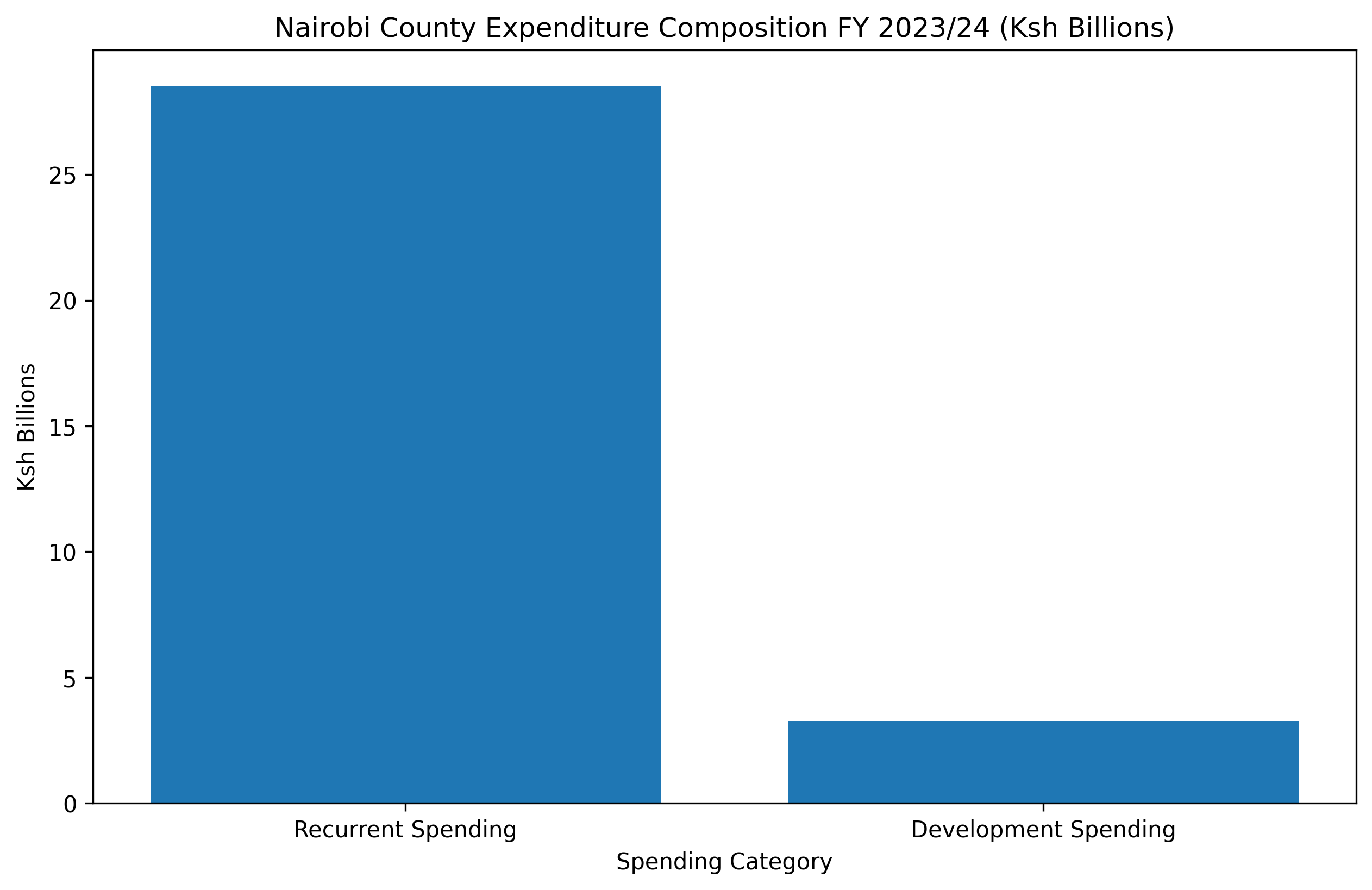
The spending structure shows a fiscal machine oriented toward maintenance rather than construction. Recurrent expenditure absorbs the overwhelming share of the budget, leaving development spending structurally marginal. A city financing its bureaucracy far more reliably than its infrastructure.
The gap between what the county said it would raise and what it actually raised was not rounding error. It was Ksh 7.2 billion enough to build and fully equip twelve Level IV hospitals or lay sixty kilometers of properly engineered urban drainage. Total expenditure for the financial year reached Ksh 31.79 billion against a target of Ksh 42.86 billion, with development expenditure coming in at a mere Ksh 3.268 billion while recurrent spending absorbed Ksh 28.52 billion. For every shilling Nairobi spent on building something, it spent nearly nine shillings on the machinery of spending itself such as salaries, allowances, fuel, committee sittings and administration that administers nothing.
The FY 2024/25 budget grew to Ksh 43.56 billion, the highest ever recorded, with Ksh 29.3 billion for recurrent and Ksh 14.2 billion for development, funded by projected national transfers of Ksh 22.5 billion and own-source revenues of Ksh 20.06 billion. Own-source revenue target was again aspirational. The county has never once hit its OSR projections under Sakaja. The pattern is points to budget ambition inflated at presentation, deflated at collection and absorbed at the recurrent line.
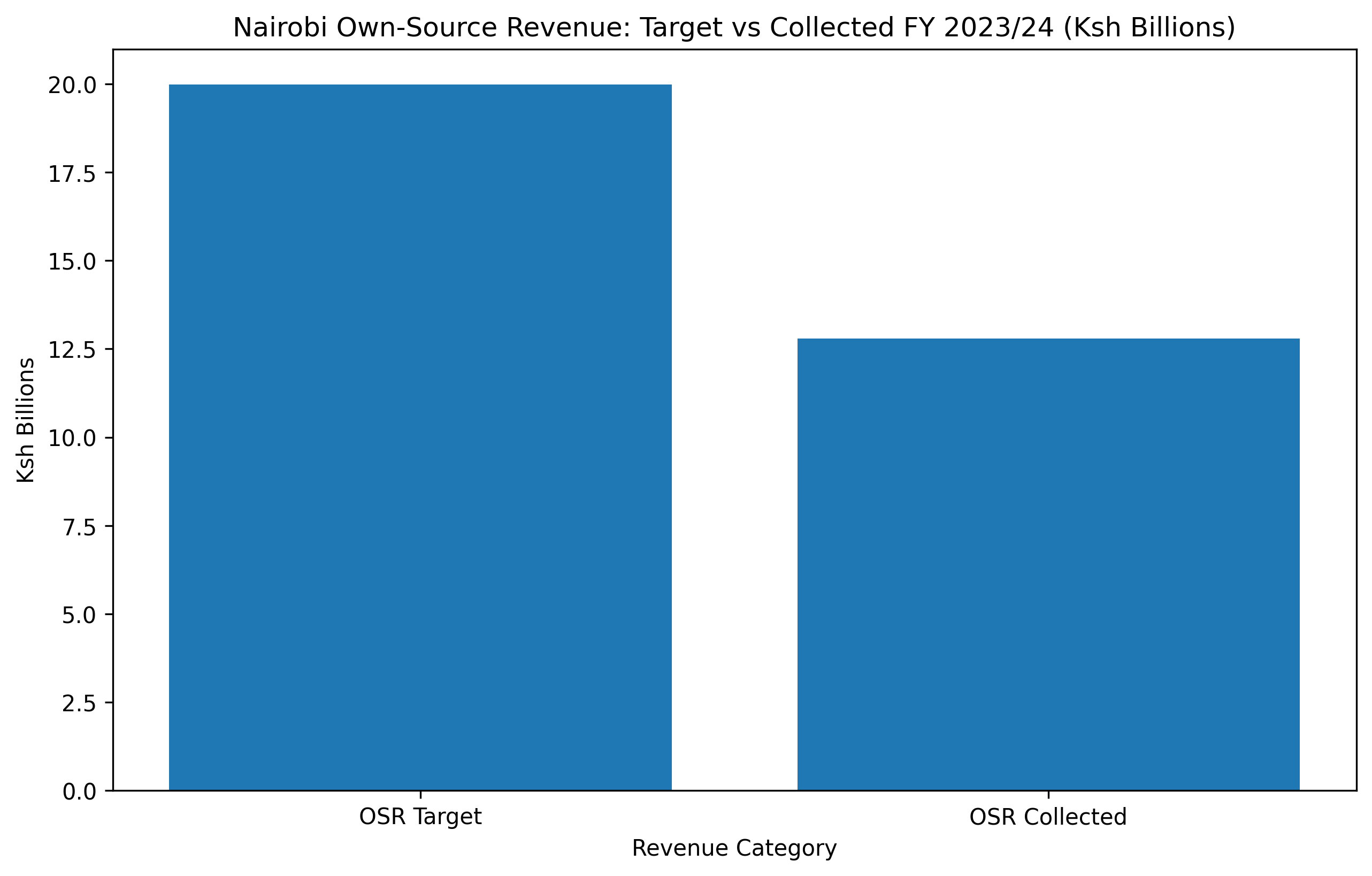
The revenue chart exposes a structural credibility gap between projections and collection. A 64 percent realization rate indicates that the budget framework is built on optimistic assumptions rather than enforceable revenue systems. The consequence is predictable compression of development spending once real cash flows materialize.
National Treasury's own report confirmed that Nairobi allocated a paltry 10.3% of expenditure to development in FY 2023/24, placing it among the bottom ten counties nationally, in direct violation of the Public Finance Management Act's 30% development floor requirement. A city receiving the largest equitable share allocation of any county in Kenya, governing a GDP that constitutes nearly 60% of the national economy, spent 10.3 cents of every development shilling on developing itself. The rest paid for itself to exist.
Total county budgets have continued to rise in nominal terms. However, the increase does not translate into proportionate capital formation. The trend reflects fiscal expansion without institutional transformation of spending priorities.
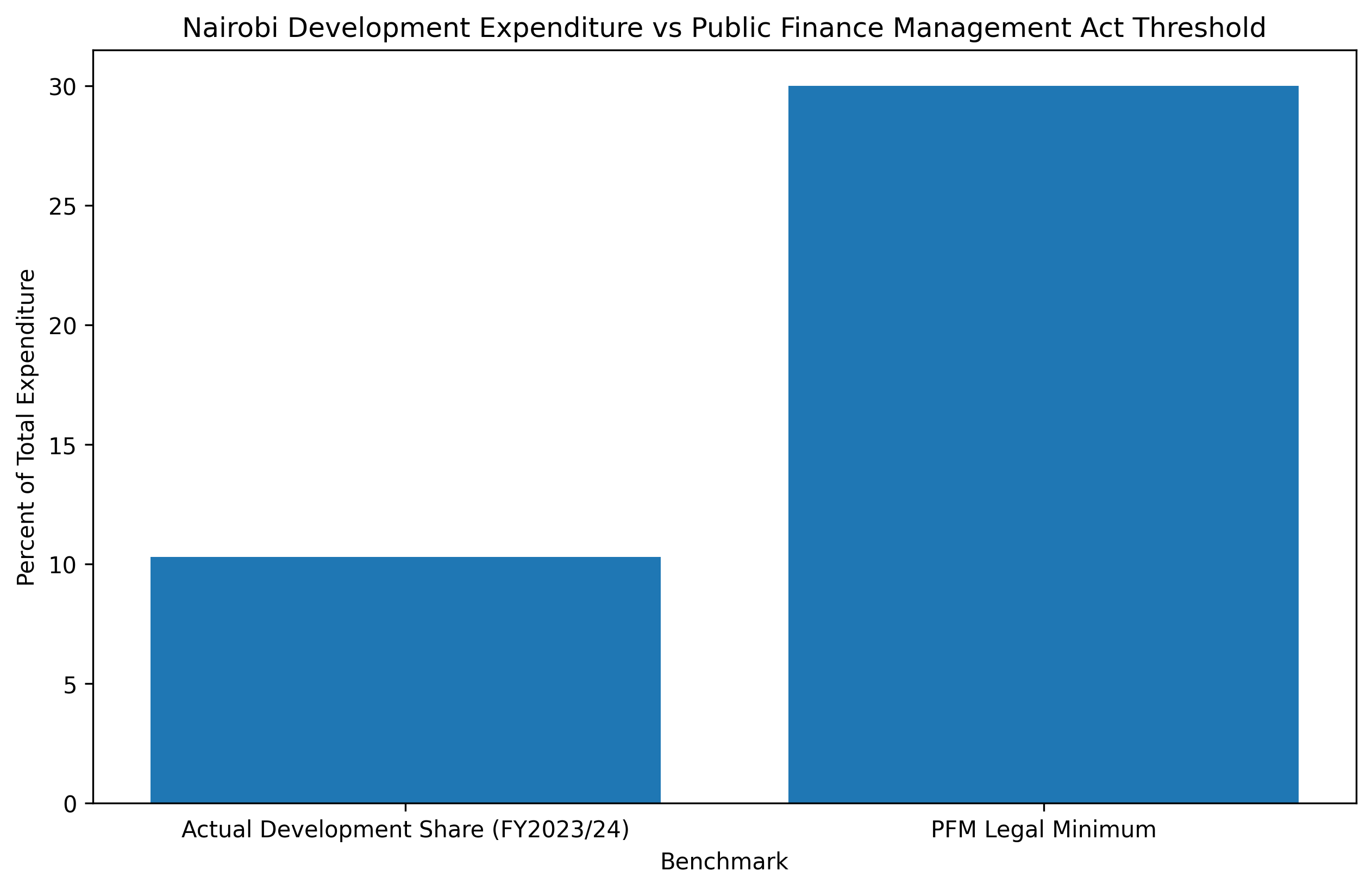
Nairobi’s 10.3 percent development expenditure placed beside the statutory 30 percent requirement in the Public Finance Management Act represents a structural deviation from the legal design of county budgeting. A city operating at one-third of the required development floor will predictably accumulate infrastructure deficits.
The sectoral allocations tell a devastating story. Health received Ksh 1.4 billion in the 2023/24 budget of which Ksh 1 billion was directed to construction and rehabilitation of facilities. Infrastructure and mobility, which governs the roads and drainage that flood every March, received Ksh 1.1 billion in that same year, for a city of six million people covering 696 square kilometers of road network. Environment, water and sanitation sector received Ksh 3.4 billion in the 2024/25 proposed budget covering solid waste, drainage, rivers and sanitation simultaneously. Solid waste management alone, which is one of the primary cause of drain blockage and therefore flooding, has never received a dedicated ring-fenced allocation adequate to the scale of the problem.
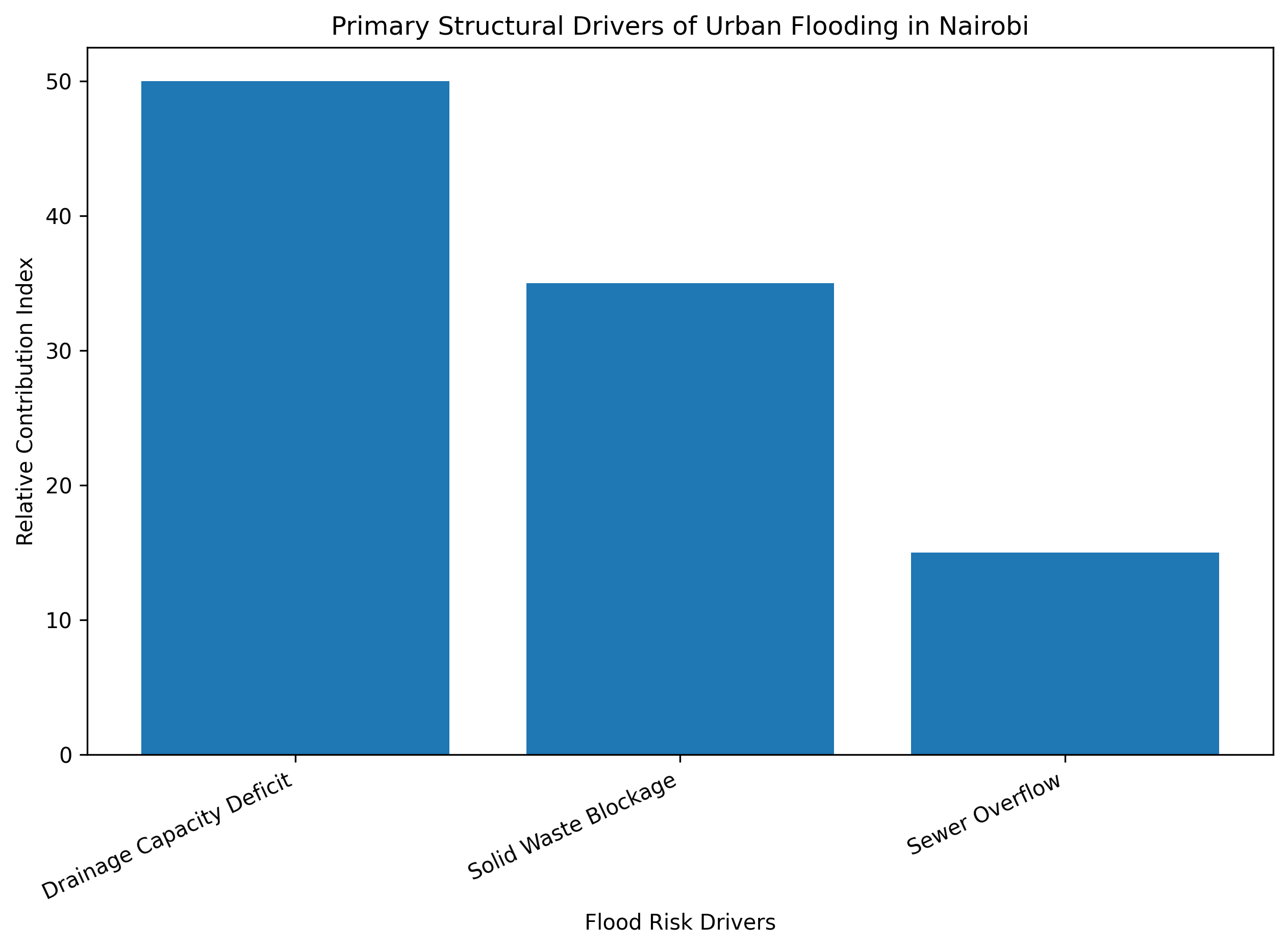
Urban flooding in Nairobi emerges from interacting infrastructure failures rather than rainfall intensity alone. Drainage capacity deficits, solid waste blockage and sewer overflow together form a cascading system that amplifies flood risk. Addressing only one of these components produces visible but temporary relief.
Nairobi River cleanup, drainage rehabilitation and wetland restoration all compete within a single envelope that is structurally insufficient before the first tender is published. The economic stimulus allocation of Biashara Fund for SMEs received Ksh 100 million. One hundred million shillings for the economic engine of East Africa's informal economy. The recording studio for talented youth received Ksh 20 million. These are not numbers. They are a statement of priorities.
NMS
The Nairobi Metropolitan Services period (2020 to 2022) is politically radioactive and analytically indispensable. NMS received Ksh 27.2 billion in FY 2021/22, with Ksh 18 billion for recurrent and Ksh 9.2 billion for development. A development allocation nearly three times what Sakaja's county would achieve in 2023/24 in absolute terms, deployed over a shorter period, with military-grade procurement discipline. NMS was widely credited with cleaning garbage, rehabilitating rivers, expanding the road network, tarmacking roads, uplifting slums and building hospitals and health centers at a pace the county had never achieved before or has achieved since.
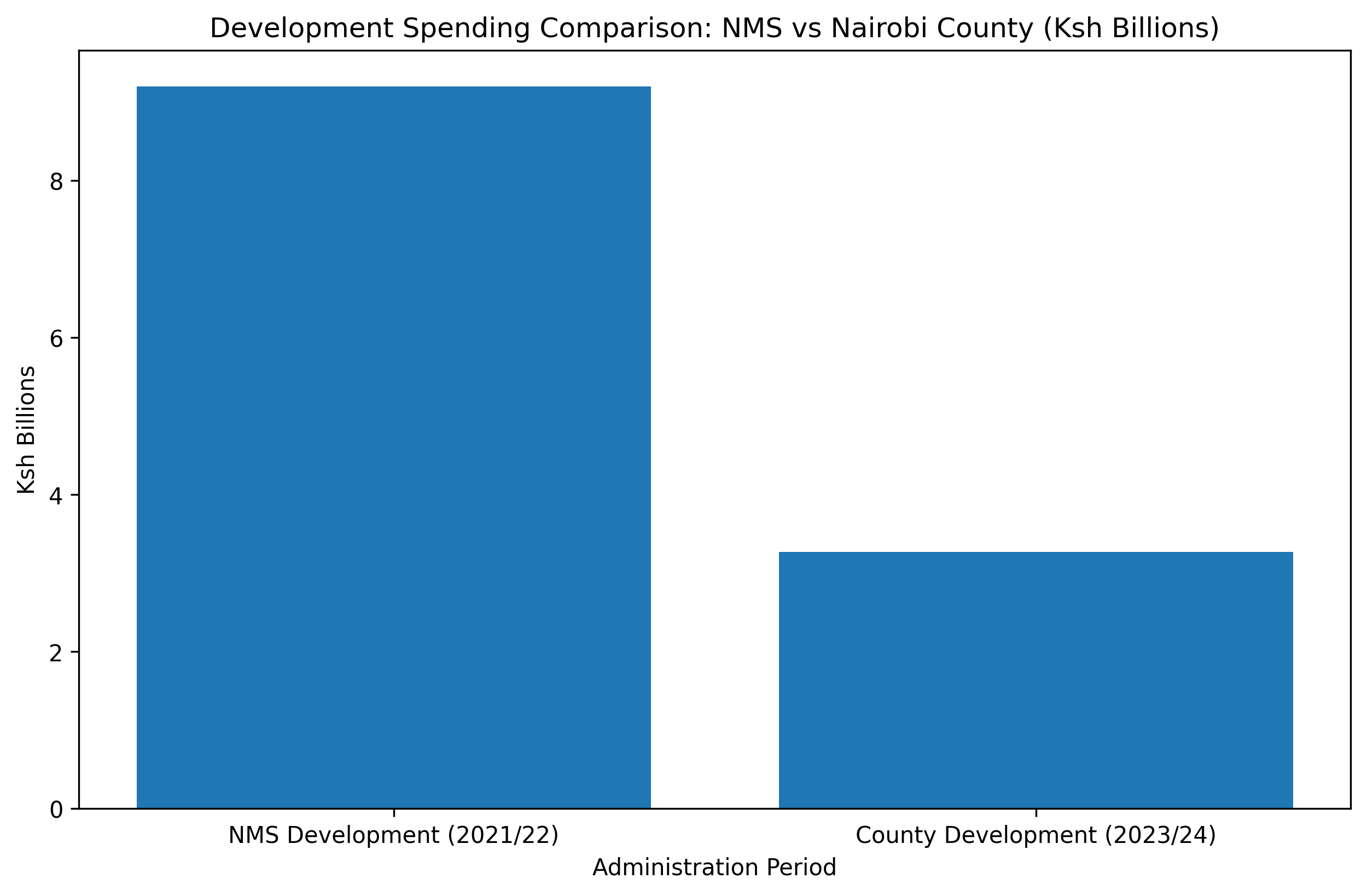
Nairobi Metropolitan Services period deployed nearly three times the development capital in absolute terms. This difference is not merely administrative but institutional. Procurement discipline and centralized execution translated fiscal allocation into visible infrastructure.
The drains that fail in 2026 are, in many cases, drains that NMS built. The roads that have the flood traffic are, in several corridors, NMS roads. This is not an argument for military administration. It is an argument that the question was never military versus civilian. It was always accountability architecture versus its absence.
The NMS era ended leaving behind Ksh 16 billion in pending bills. A figure that should temper any uncritical nostalgia. Speed without systems produces its own debt. But the comparison between NMS's development expenditure ratio and the county's current 10.3% is a development economics indictment. A city cannot build its way out of a structural maintenance deficit at 10.3% development spend. It cannot. The mathematics simply do not permit it.
80 Billion Pact
On February 17, 2026, President Ruto and Governor Sakaja signed a cooperation pact at State House establishing a joint responsibility framework covering housing, roads, water, waste management and street lighting, with an estimated Ksh 80 billion investment envelope. Ruto anchored the agreement in Article 189(2) of the Constitution, which requires cooperation between national and county governments, as well as provisions of the Intergovernmental Relations Act and the Urban Areas and Cities Act, clarifying that the deal does not transfer county functions but structures national support in areas where capital performance affects the entire country.
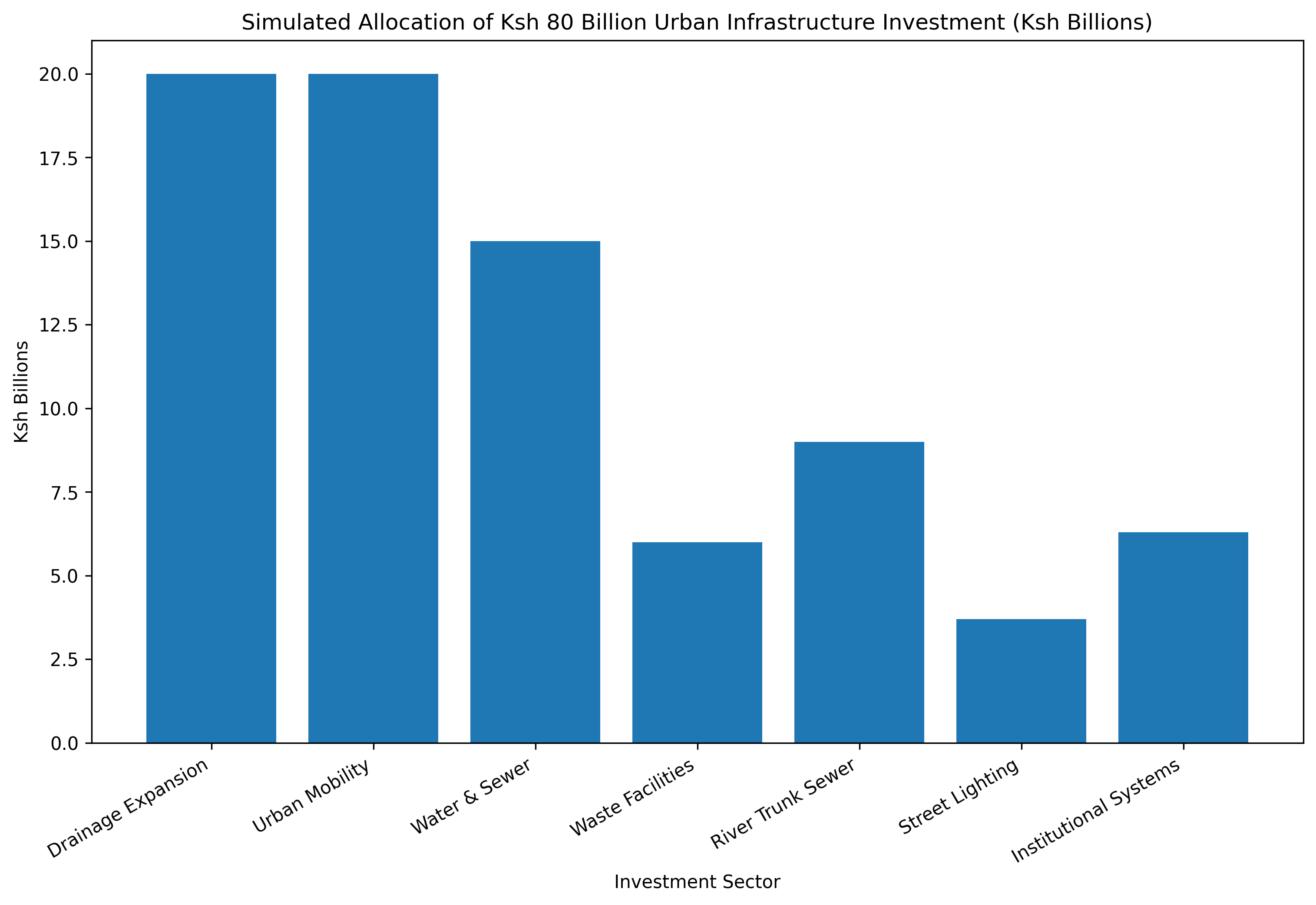
A concentrated infrastructure program could systematically address drainage, waste, water, mobility and lighting deficits. The distribution emphasizes network infrastructure that generates compound urban productivity gains. However, the success of such an envelope depends less on the amount than on the institutional system that governs procurement, revenue capture, and maintenance.
The specific commitments are not trivial. Ksh 9 billion for twin trunk sewer lines along the Nairobi River corridor, Ksh 3.7 billion for street lighting, Ksh 2.1 billion for the Ng'ethu Water Treatment Plant, and Ksh 4 billion from the county plus Ksh 2 billion from the national government for solid waste material recovery facilities.
These are real numbers addressing real deficits though the pact is constitutionally, procedurally and politically problematic in ways that its cheerleaders are moving too fast to acknowledge.
The Law Society of Kenya warned that the Ksh 80 billion framework risks becoming a cousin of the discredited NMS model. The Katiba Institute also filed formal demands for disclosure of the legal basis, financing and the County Assembly's involvement. Nairobi Senator Edwin Sifuna described it as a power grab through the back door, noting that of the twelve-member Steering Committee, eight are appointees of the National Government. This is the structural tell. You can call something cooperation but when eight of twelve votes on the governing committee belong to one party with the money, the word cooperation is doing very heavy lifting. The High Court has certified a petition challenging the constitutionality of the agreement, with a hearing scheduled for March 16.
The deeper problem is not the pact's content. The deeper problem is what the pact implicitly concedes. After thirteen years of devolution, the county structure has so comprehensively failed the capital that the national government must re-enter through a Ksh 80 billion checkbook that achieves the same functional result by different paperwork. The pact is the admission that the county cannot govern this city adequately. It is just an admission that nobody is allowed to make in those words.
Alternative Structure
The problem with the pact, and with every version of this intervention that Kenya has attempted since 2013, is that it treats a structural failure as a resource problem. Nairobi does not primarily need more money. It needs a different governing architecture with different accountability mechanics.
A Nairobi Capital City Authority, constituted under Article 184 of the Constitution and a dedicated Nairobi Capital City Act, would extract the city from the county framework entirely by recognizing, as the constitution already allows, that a capital city bearing national and international functions is categorically different from a county and requires a categorically different governance instrument. The Authority would be governed by a Board with statutory representation from the national government, elected Nairobi residents, professional bodies and the business community. Plural principals with competing interests and transparent mandates and not a steering committee weighted 8:4 toward whoever controls the Treasury. Its CEO would be a professional city manager, competitively recruited, fixed-term and performance-contracted away from political appointee whose tenure depends on the governor's mood and the MCAs' tolerance. This model exists in law. Article 184 mandates Parliament to enact legislation for the governance of Nairobi. That legislation has never been enacted. Fourteen years after the Constitution. This is not an oversight. It is a choice.
Revenue reform is the second structural intervention and it cannot be cosmetic. Nairobi's own-source revenue potential is estimated, conservatively, at between Ksh 35 and 40 billion annually. Nearly three times what the county currently collects. Land rates are assessed on 1980s valuations. Parking is manually collected in a city where every vehicle is registered and GPS-traceable. Building permits are undercharged and over-exempted. A digitized, third-party-audited revenue management system would transform the county's fiscal position without a single shilling of additional national transfer. The reason this has not happened is political. The gap between what should be collected and what is collected is where discretion lives and discretion, in this city, is the currency of political survival.
Hypothecated sector budgets through ring-fenced and constitutionally minimum allocations for drainage, solid waste and sanitation would prevent the annual raid on development budgets by recurrent pressures. Amsterdam's storm water management authority operates on a dedicated levy that cannot be repurposed by the city council. Singapore's National Environment Agency has a statutory budget floor. Nairobi's drainage budget exists as a line item in a document that is amended four times before a tender is published. A minimum 5% of total county expenditure directed exclusively to drainage and solid waste infrastructure would over a five-year period fundamentally change the city's flood resilience. It is not a radical idea. It is a basic principle of urban infrastructure financing that Nairobi has simply never applied.
80 Billion Simulation
Ksh 80 billion, properly deployed through an accountable urban authority with functioning procurement and zero pending bills tolerance, would do tremendously well for this city within four years.
Complete the Nairobi River corridor trunk sewer at Ksh 9 billion and eliminate the primary source of drain blockage in the lower city. Build four material recovery facilities at Ksh 6 billion and reduce by 60% the solid waste that enters drainage channels every year. Rehabilitate and expand 400 kilometers of urban drainage at approximately Ksh 20 billion which is enough to manage a one-in-fifty-year rain event across the entire metropolitan area. Fully operationalize Nairobi's 70,000 street lighting points at Ksh 3.7 billion, reducing crime and improving nighttime economic activity by a measurable margin. Expand water supply and sewerage to informal settlements at Ksh 15 billion, which current evidence suggests reduces public health costs by a ratio of approximately 1:8. Fund a five-year urban mobility plan for BRT corridors, traffic signal modernization and non-motorized transport infrastructure at Ksh 20 billion, reducing the average commute time in this city by an estimated 35%.
The remaining Ksh 6.3 billion builds the institutional infrastructure of digital revenue systems, urban planning data platform and professional city management structure that makes all of the above sustainable rather than a one-cycle project that deteriorates when the political winds shift.
Ruto said, on the day of signing: "We do not want a flooded city this year." It is a claim that should be read very carefully. This year. The phrasing of a politician managing an event, not an institution building a system. Ksh 80 billion will do what all previous investments in this city have done, produce real but perishable results in the absence of structural reform, unless the governance question is answered simultaneously with the infrastructure question.
You cannot build your way to a functional city with a dysfunctional government. You need both. The money is finally on the table. The government that will spend it is the same government that collected 64.1% of its own revenue target and spent 10.3% on development and is now, fresh from that performance, being handed eighty billion shillings and a Steering Committee it does not control.
The flood is outside. The question is inside. As it has always been. The Public Finance Management Act requires 30% on development. Nairobi achieved 10.3%. No one has been charged.
Recycling Politicians
The drains stay blocked because the contractor who unblocks drains is the same contractor who funded the campaign and the campaign debt does not get paid in working drains. It gets paid in the next tender. The next county. The next term.
Buildings continue going up on floodplains because the approvals continue being signed by people whose re-election is financed by the people who need those approvals. This is corruption in the institutional sense. A structural and mutually understood sense where everyone in the room knows the rules and the rules have nothing to do with the building code.
The professional class continues being furious on the internet. They are sharp, well-cited and occasionally brilliant. Ultimately they then vote along the same fault lines as everyone they are furious at because in the final analysis, the tribe, insider and known quantity delivers something, and something, when the state has trained you to expect nothing, is rational.
The city gets worse. Gradually. A building with a compromised foundation gets worse invisibly, tolerably, until the morning it does not. Each election cycle the baseline of acceptable decay is recalibrated downward. What would have been scandalous in 2013 is unremarkable in 2026. What is unremarkable in 2026 will be nostalgia in 2035.
The worst outcome of reelecting the same is not the next flood. It is the normalization of the flood. The moment, and we are dangerously close to it, when nobody writes threads about it anymore because everyone has simply accepted that this is what rains in Nairobi are. Water. Standstills. County statements. NTSA advisories. The city as managed decline. Presented as resilience.
Singapore Dreams and its Worst Prognosis
Every few years in a manifesto, a TED-adjacent talk, a county development plan or a foreign-funded urban resilience report, someone invokes Singapore. Lee Kuan Yew. The transformation. The miracle of a small, resource-poor, politically complicated place that decided to be serious and became, within a generation, one of the most functional cities on earth.
The Singapore dream, in Ruto’s imagination, is a story about what is possible. Will. The decision to govern properly overriding every structural disadvantage.
This is an inspiring story. It is also, in its Kenyan application, a fantasy being used to defer a reckoning because Singapore did specific things that the Singapore dream, as deployed in Nairobi, carefully omits. Lee Kuan Yew broke the unions that protected incompetence. He prosecuted corruption at the top. The small corruption, large, well-connected and politically expensive corruption. He built institutions deliberately immune to the electoral cycle. He made meritocracy structurally mandatory and not aspirationally encouraged. He did things that were genuinely, measurably unpopular with powerful people and did them anyway, and the system held because the institutions were built to hold.
The Singapore dream in Nairobi takes the aesthetic and leaves the surgery. It wants the gleaming buildings and the smart city infrastructure and the investor confidence and the regional headquarters, all of which Nairobi is aggressively, sincerely pursuing, without the institutional reformation that made those things possible in Singapore and sustainable elsewhere.
It works. Partially. For some. The Nairobi Expressway exists. It is real, functional and beautiful. It floats above the flood. The malls work. The fiber is fast. The coffee is excellent. The creative economy is genuine and talented and internationally recognized. The upper decile of this city lives extraordinarily well by any regional standard. The Singapore dream delivers to a corridor, class and few lucky ones in ways that are photographable and investable and compelling enough to sustain the narrative.
While below in Mathare, Kibera, Mukury, in every neighborhood that is not on the investor map, the drains fail and the rivers rise and the buildings go up without permits and the county collects rates it does not return as services and the gap between the city on the presentation slide and the city in the floodwater grows, quietly, every year, into something that is no longer a development gap.
It becomes a political fact.
The worst prognosis of the Singapore dream is not that it fails completely. It is that it succeeds enough for enough people, in enough ways, to make the structural failure of the rest of the city politically tolerable. Indefinitely. A city that is simultaneously a regional success story and a site of managed abandonment for the majority of its residents. Neither collapsing nor reforming. Just stratifying. Hardening. The expressway above. The floodwater below.
That is not a natural disaster. That is a choice. Made every five years. By us.
The Singapore dream without Singapore's institutional ruthlessness is a render. A very expensive and beautiful render of a city that does not exist.