
Rainbow

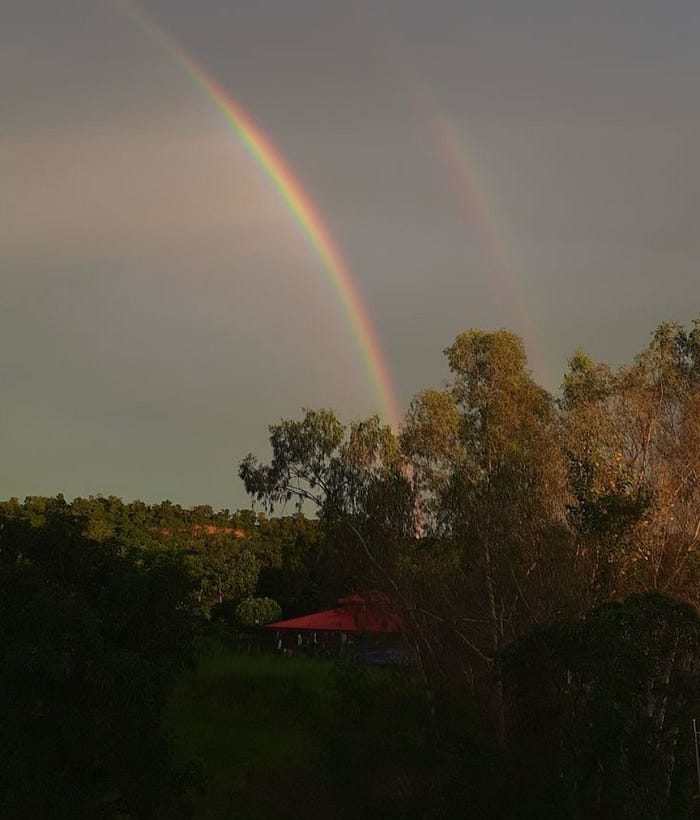
Dust and Distance
The matatu lurches through Kisumu’s morning chaos, spitting diesel fumes into life. I’m wedged between a mama with a basket of omena and a university student whose headphones leak Gengetone beats. My phone buzzes. Sori, again. I silence it.
Nyakach stretches before me like a faded photograph, all red earth and thorny Kanyamlori acacias. Two hours from the city, a lifetime from everywhere else. dana’s waiting there, in that house that smells of dettol, rosemary, wood smoke and forgetting.
Three weeks ago, Kilifi.
Sori stands in her kitchen, sunlight slicing through the window, catching the anger in her eyes. “You can’t keep running to Nyakach every time, Ochuka. She doesn’t even remember you half the time.”
“She’s my grandmother.”
“And I’m what?”
I’d left without answering. Some questions are traps disguised as invitations.
I’m the only one who descends here, always. The dust settles on my shoes. Good shoes. Nairobi shoes
already regretting the journey. The rest of us hurtle towards Chabera. Next stop Oyugis. My hesrt is home.
Dana sits on the veranda, staring at Lake Victoria’s distant shimmer. Over a tamarind tree on Freddie’s compound. She’s smaller than last time. Forgetting has weight and she’s shedding it in increments.
“Dani,” I say, approaching carefully.
She turns. Her eyes are both present and absent windows to an abandoned house where someone occasionally lights a candle.
“Who let you in?” She doesn’t recognize me. Not today.
I settle beside her anyway. This is what we do. We persist in the face of erasure.
Absence
What do you owe people who’ve forgotten they raised you? Dana taught me to count in Dholuo before I knew Swahili, showed me which stars told you rain was coming and made me type an apology, for my exclusion in class six when I protested bullying from prefects, on the typewriter without mistakes for three weeks. She braided my sister Atis’s hair so tight we joked she was trying to straighten out our thoughts. Now she asks me three times in an hour if I’ve eaten, each time with fresh concern. The previous offerings never existed.
Alzheimer’s steals memory and rewrites the contract of family, makes you sign up for love that may never recognize itself in the mirror.
Uncle Otis appears from the shamba, machete in hand, looking. He’s been fighting the earth and losing. He’s dana’s third youngest, stayed behind when the rest of us scattered to Nairobi, Mombasa, Sweden. Someone had to.
“Doki. Ber?”
“Ber ahinya.” I’m lying. Nothing is well.
“She had a bad night. Thought I was your grandfather, started asking about cows he sold in 1987.” He laughs but it’s hollow, a sound that’s forgotten how to mean joy. “Called me a thief.”
We stand together. Dana is watching nothing in particular.
“You know what she said yesterday?” Otis continues, sitting heavily. “Said she wanted to go home. I told her, ‘Mama, you are home.’ She looked at me like I was simple. ‘Not this place,’ she said. ‘The home before the forgetting.’”
You think you understand grief until you grieve someone who’s still breathing. You sit across from someone who built your childhood and realize they’ve demolished it room by room in their min and there’s no blueprint for reconstruction.
Ghosts
My phone keeps buzzing. Rono and Gigi, my friends from our Kitsuru days back when we thought money could solve everything and make parallel lives intersect.
Rono (text): Funeral planning committee meeting. Your presence is requested, Mr. Absentee.
Gigi: He means we miss you. Come back to civilization.
They don’t understand. How can you explain that sometimes civilization is exactly what you need to escape and grandmother’s confusion in shagz feels more honest than any boardroom in Westlands?
My daughter, fourteen and already wiser than me, hugging me at the airport. Sweden has better schools, future and everything.
“Baba, you’ll visit?”
“Every school holiday, I promise.”
She’d looked at me with dana’s eyes, seeing through the lie. Children inherit the ability to detect stirring depth; it’s genetic.
Two years later, I’ve visited once. Promises are like Nairobi traffic — , always moving but never arriving.
Dana suddenly grabs my wrist. Her grip is surprising, steel wrapped in papyrus skin.
“I know you,” she says and for a moment, the clouds part. “You’re the boy who cried for a week when baba left.”
I was nine. Haven’t thought about that day in decades.
“Mama…”
“Where did he go?”
“I don’t know. He just… left.”
She nods, this explains everything, then releases me. The clouds return. She’s back to staring at the tree, at something beyond sight.
Memory is not democratic. We don’t remember the good days and bad days in equal measure. We remember the extremes. The day everything broke, and JaPlan was lowered inside a finely crafted mahogany brown and everything aligned. The vast middle of me joining UoN, ordinary Tuesdays and unremarkable Sundays taking dana to church and waiting for her outside the gate till service is over. They dissolve like sugar in chai, sweetening the whole without leaving trace.
Dana remembers my grandfather dying but not what we had for breakfast. Her mind curates ruthlessly.
Dancing With What Remains
Sori calls. This time, I answer.
“Where are you?” Her voice is tired, not angry. Worse.
“Home.”
Silence. Then: “Love, we need to talk. Really talk.”
“I know.”
“Do you have to think about tomorrow?”
The truth is a stone in my chest. “That’s not fair.”
“Fair?” She laughs, sharp as broken glass. “You want fair? Fair is me moving to Kilifi to and still learning to love your silences and absences. What’s not fair is you treating me like a layover between your pains.”
“Sori — “
“I love you. God help me, I do. But I can’t keep loving someone who won’t stay still long enough to be loved.”
The line goes quiet. Not dead. I can hear her breathing. The Indian Ocean behind her, constant and unconcerned with human drama.
“Come home,” I say finally. “Meet her. Meet the woman who taught me that love means showing up, even when it’s hard.”
“Ochuka, she won’t remember me.”
“No. But I will.”
Dana stands. Falls. Uncle Otis catches her. She calls him “Baba.” He doesn’t correct her.
The sun sets. The sky is unforgivingly a molten copper.
Atis arrives from Nairobi, lawyer papers in hand. “We need to talk about care options,” she says, and Uncle Otis’s face hardens. Clay in kilns.
Rich and Gigi send a photo of them at J’s Fresh Bar, raising drinks. Caption: To absent friends.
Awuor messages: Baba, can we FaceTime? I type “tonight” and hate myself.
Sori sends her location. She’s driving. From Kilifi. Seven hours through the night.
Rainbows
Night in Nyakach is absolute. There are no streetlights to dilute the stars or traffic to drown the insects. Dana sleeps, sang her hymns into peace. Uncle Otis and I sit outside, sharing hibiscus tea from a plastic cup.
“You know what kills me?” he says. “She raised eight children. Buried 5. Survived drought, eye surgery, Moi’s years, cattle raids, diabetes… everything. Now she can’t remember where the bathroom is.”
“Uncle — “
“No, let me finish. I used to resent her. Tough woman, no patience for weakness. You know what? She was preparing us. For this. For the day when she’d need us to be strong.”
He pours more tea, hands shaking.
“Atis wants to move her to her place in Nairobi. Says it’s better care.”
“What do you want?”
“I want her to live knowing where she is. In this house. Looking at that jacaranda tree. Even if she can’t remember why it matters, I’ll remember for her.”
This is what love looks. A choice you make every morning against every instinct that says run. Uncle Otis hasn’t had a full night’s sleep in two years. His businesses failing because dana wanders at 3 AM. His marriage strained because caretaking leaves no energy for romance. Here he is, choosing this, choosing her, choosing the hard consideration of family.
And me? I visit twice a month. I deserve no medals. We’re all performing love, but Otis is the only one actually doing it.
Headlights slice through the darkness. A car I don’t recognize parks and Sori emerges, looking exhausted and beautiful and angry and here.
“You’re insane,” I say, walking toward her.
“We established that when I fell for you.” She looks past me at the house. “Is she awake?”
“No.”
“Good. Then you can’t run yet.” She takes my face in her hands, forces me to look at her. “Ochuka, I understand grief. I understand duty. What I don’t understand is why you think you have to carry it alone.”
“Because — “
“Because nothing. Your daughter is in Sweden learning to live without you. Your grandmother is here loving you. And I’m in Kilifi waiting for you to decide which ghost you’re chasing. But here’s the thing about ghosts, darling… they’re already gone. The living? We’re still here.”
Breakfast and Resurrections
Morning comes whether you’re ready or not.
Dana shuffles to the veranda, sees Sori and something miraculous happens. She smiles. “I know you. You’re the one who makes him laugh.”
Sori freezes, looks at me, looks back at dana.
“Sometimes, ma’am.”
“Good. He’s too serious. Like his grandfather.” Dana settles into her chair and then turns to me. “Ochuka, have you eaten?”
For the first time in months, I don’t feel annoyed by the repetition. “Not yet, dani.”
“Otis!” she calls. “These children need breakfast!”
Memory is a traitor but sometimes it’s a prophet. Dana doesn’t remember yesterday. She remembers the shape of love and the contours of care. She’s forgotten my name before but never forgotten to ask if I’ve eaten. In the mind, how-to-love outlasts the superstructure of facts and faces.
Uncle Otis makes tea. We sit together five of us, because Atis arrived at dawn with her forms and her logic.
“We can’t keep doing this,” Atis says and Uncle Otis tenses. “We need a plan.”
“The plan is she stays here,” Otis says flatly.
“For how long? Until she falls again? Until she walks into the hill?”
Dana watches us argue over her like we’re discussing weather. Then she speaks: “I had a daughter once. Beautiful girl. She died.”
We all stop.
“She was four months old. The forgetting came after that. Never could find my way back to before.”
Uncle Otis’s eyes fill. “Mama, that was your mother. Your mother lost a child.”
“Did she?” Dana looks confused, then serene. “Well. Someone did. Someone is always losing someone. That’s what living costs.”
Sori drives me back to Nairobi. We don’t talk about futures or promises. Her hand in mine. The road unfolding, the agreement to try.
I FaceTime Awuor. She’s taller. Her Swahili has Swedish rhythms now. “Baba, when are you visiting?”
“Soon.” Then, because lies are heavy: “ Christmas. Definitely next summer.”
“Can Grandma travel?”
“No, sweetheart.”
“Then I’ll come there. She shouldn’t forget all of us.”
Fourteen years old. Already understanding what it took me thirty to learn.
Grace organizes a dinner. Westlands, expensive wine, the life I keep half-living.
“Where’ve you been, man?” Jim asks.
“Dala. With my grandmother.”
Grace raises her glass. “To grandmothers. To the women who teach us how to be human.”
We drink. Cr once, I’m fully present.
Uncle Otis texts: She asked for you today. Didn’t use your name, just said “the professor.” I said you’d come soon. Don’t make me a liar.
I text back: This Saturday. I’ll bring Sori.
Good. She needs more people to forget.
Home Before the Forgetting
Three months later, I’m back in dala. Dana’s worse. The hill is eternal. Sori knows the way now without GPS.
Dana looks at me and says, “I had a grandson once. Strong boy. Too much like his grandfather… carried the heavy books on his shoulders instead of wroting on his lap.”
“I’m right here, mama.”
“Are you?” She smiles. “Good. Don’t leave before you’ve eaten.”
Love isn’t memory. Love is repetition. The thousandth time you answer the same question with patience. Sitting on this veranda, drinking tea that’s too sweet, watching a sky that doesn’t care that we’re drowning and choosing, despite evidence and logic, to believe that what we do for each other matters. Even if we forget.
Uncle Otis says: “She used to tell me, when I was young — ‘We’re all chasing rainbows. Some of us just have the good sense to dance while we chase.’”
We stand at the front porch and I understand finally that she is teaching us her final lesson that we are all, always, becoming strangers to ourselves. What do we do with the time before the forgetting?
I text my daughter: Come home for Christmas. Let me show you where you’re from.
I kiss Sori at the airport: Thank you for chasing me.
I call Grace: Drinks this weekend. And actually show up this time.
Rainbows don’t wait for permission. Neither should we.
For Dana, and all the grandmothers who teach us that love is just showing up, over and over, even when memory fails. Especially then.