
Remembering Baba
Duog Itera Bayo

By then, mornings gelled between dignity and pain. He still refused hot water unless fever pinned him flat. At five-thirty, before the weaver birds and cold breeze from uphills began their daily argument outside, I would hear his wooden door click softly.
“Come, daktari,” he would whisper, embarrassed by needing help but too proud to say it plainly. I would hold his elbow as we crossed the cold corridor toward the toilet, his body lighter than a grandfather’s body should have been, his palm dry and papery against my wrist. Afterwards, he still insisted on bathing himself. Cold water. Every morning. The splash of it sounded violent in that quiet house. Then we would step outside to the small garden while dawn spread slowly over the ridges. He pruned flowers tenderly, like he was apologizing to them for cutting them back.
“A man must tend to beauty around him,” he told me once while handing me the small rusted shear. “Even if it is only bougainvillea for people passing the road.”
On Sundays he played piano after breakfast, old hymns and Congolese melodies drifting through the sitting room while I sat cross-legged beneath the piano bench tracing shapes on the tiles. Sometimes he stopped midway through a song because his fingers cramped. “These hands are retiring before me,” he laughed warmly, shaking them out. I hated school during those months. Every morning I wore my uniform with resentment boiling in my chest because school meant hours away from him, hours where something could happen while I was gone.
One morning near the gate, I burst into tears and said, “What if you die while I’m in class?” He looked at me for a long time, tired eyes behind thick glasses, then touched my cheek gently. “Then I will still have died loved,” he said. “And that is not a bad way for a man to go.”
Breakfast was sacred to him. Even illness could not steal that discipline completely. A philosophy of care refined over decades. Slices of nduma or fried cassava rested beside sharp homemade pickles; two eggs sat upright in the little egg breaker awaiting their gentle crack; a well-done omelette folded neatly beside orange wedges or mango slices because he believed a morning without mango was an emotional deficiency; three biscuits arranged carefully near a small mug of uji still steaming softly.
A thermos of hot milk stood near the Japanese porcelain kettle whose delicate blue flowers had started fading with age, and beside it were always three tiny cups with matching saucers: one for him, one for dana, and one for the possibility of another human being visiting us into the day. That detail still undoes me. The third cup. The assumption that hospitality must remain prepared even before the guest arrives.
I never understood how dana managed to wake early enough to prepare everything so beautifully but perhaps she knew from him that feeding people properly was not domestic routine but moral practice. This was a man who once cooked and packed meals for his wife ahead of tiring work weeks because he considered hunger an indignity nobody he loved should go through alone. Food, to him, was an irrevocable gift of loving, perhaps the only undefeated act of kindness left in the world. Before touching anything, he would bow his head slightly and read a Bible verse in that calm measured voice of his, then softly say thank you after every serving, every refill, every small act, while dana blushed and waved him away shyly like a little girl embarrassed by praise she secretly treasured.
He still wore crisp shirts at the table though his shoulders had narrowed inside them. One morning he sat peeling a sandhra orange near the dining room window while the TV murmured in the background. His hands trembled badly that day. Juice ran down his fingers and stained the white linen across his lap. For a moment he stared at it silently, almost offended by his own body. I reached for the orange, trying to help before embarrassment hardened inside him.
He smiled then, tired but amused. “That’s the joy of life, love comes back to stain your good clothes, son.” I remember laughing without fully understanding him. I finished peeling it and handed him water from the old dispenser that stood near the fridge, the cream-colored one with faded blue flowers near the tap. He drank slowly while watching me.
“You know why old people repeat stories?” he asked. I shrugged. “Because memory becomes a chair. You sit on the same piece every day.”
He pointed toward his study where I spent afternoons dusting books and arranging papers while dana slept on the carpet near the window.
“One day these books will become noise to everybody else,” he told me. “But if you remember how I laughed, coughed and walked with you to Kisumo, then they are in good hands.”
Later we walked slowly to his office at the local market, greeting hawkers and mechanics and women selling groceries by the roadside. Everybody respected him there. Even illness could not fully remove the authority from his voice. At the office he let me stamp old documents while he corrected ledgers with a fountain pen.
“Good handwriting,” he told me, adjusting my grip carefully, “is a sign that somebody believes tomorrow exists.”
At night I washed his feet before bed. Both his and dani’s. Dani always protested dramatically while my grandfather laughed weakly from the edge of the bed. His feet frightened me sometimes. Thin. Veined. Fragile in ways that did not match the man who once carried boxes of books and repaired broken radios with bare hands. He still spoke about future things constantly.
“When you are older, I’ll show you Muhoroni after the rains,” he said one evening while I dried his feet gently with a towel warmed near the heater. “The soil smells alive there.”
I nodded even though part of me had already begun understanding he was speaking from a country he would not fully reach with me. Before sleeping, I cleaned his study while he watched from the doorway. The room smelled of dust, eucalyptus ointment, old paper and the faint medicinal scent that had settled permanently into the house.
“You know,” he said softly, “people think inheritance is land or money. It isn’t. Inheritance is habits. How a man folds silence and treats tired people. How he pours tea. How he survives humiliation.”
Baba looked at me with unbearable joy, adults do that when they already know they are becoming memory.
“You were never a burden to me,” he whispered. “Even on the days you followed me like a small shadow everywhere.”
Years later, his voice saying that still destroys me because I realize now he had already begun saying goodbye while pretending he was simply talking.
Every anniversary of the dead starts rather quietly at first. Morning fills the day normally. The kettle boils. Somebody outside laughs too loudly. Dust gathers faithfully on bookshelves. The world behaves with almost offensive continuity. Suddenly memory opens a hidden door and the dead return as habits. I remember how he folded newspapers into exact halves before reading them. How he polished his shoes even when illness had already reduced his journeys to the distance between bedroom and veranda. How he paused before speaking, as though words deserved proper tailoring before entering another person’s ears.
Even his clumsiness was meticulous. Medicine bottles aligned neatly beside the bed. Handkerchief folded twice beneath the pillow. Pens capped. Receipts arranged inside old envelopes. A beautiful man. That is what destroys me most now. Not merely that he died, but that somebody so attentive to life had to leave it. Sometimes I think grief is simply love by another name. It is the lifeline running inside the body.
Today I miss the sound of his cough from the next room. I miss hearing him clear his throat before telling a story he had already told me ten times. I miss the impossible dignity of him. The old-world gentleness. He made ordinary routines feel ceremonial. Even now, somewhere deep in me, I am still that child listening for his slippers against the corridor floor before dawn.
And God, the grace of old men when they know they are disappearing. Nobody prepares you for that. Nobody tells you how carefully the dying begin placing themselves into objects and gestures so the people they love will still have somewhere to find them. He left himself everywhere without hinting it. The piano keys are slightly yellowed with age and the garden hedges trimmed too symmetrically for nature itself. The smell of Brylcreem, eucalyptus ointment, old paper and dry cleaning fragrance on his suits. His water dispenser breathing near the dining room wall. In the baraza and market streets where people still sometimes mention his name with that brief silence people reserve for the honorable dead.
I remember one evening during the rains when electricity disappeared and we sat together in darkness listening to water strike the mabati roof. I asked him whether he feared death. He stayed quiet for so long I thought he had not heard me. Then he said softly, “No. I fear leaving people before I have loved them properly.”
I did not understand him then. I do now. Love always feels unfinished at funerals. Even after years of care, conversation, forgiveness and devotion, death still interrupts people absurdly. That is why grief aches with such unsettling grasp. You never stop reaching instinctively toward the vanished. Even decades later, some part of the heart still expects one more breakfast, one more story, one more ordinary Saturday.
So today I celebrate him not with the language of cemeteries but with the language he taught me while alive. I baba in polished shoes and watered flowers and disciplined mornings and carefully folded shirts and the dignity of showing up despite pain. In feeding children first and handwritten notes and repaired radios and the grace of men who never needed cruelty to prove authority.
I celebrate my grandfather in weeping and silence, in piano notes drifting through old rooms after rain. I celebrate him in every universe where love survives biology. Because men like him do not disappear merely from the earth. They enter people. They become posture, books, humor, conscience, routine and mercy.
Sometimes when I catch myself arranging books too neatly or pausing thoughtfully before answering someone, terror and joy strike me together because I realize the dead continue through us in embarrassingly small details. And if heaven exists, I do not imagine him winged or glowing. I imagine him exactly as he was on those tender mornings near the window; white linen shirt, neatly trimmed nails, peeling an orange slowly while sunlight washed the room, pausing to smile at a child who loved him so completely that even now, all these years later, the memory still feels warm enough to touch.
Dear Baba;
Duog itera bayo. Come back. Take me on one more journey. This is the song I wrote for Father's Day and could not finish because every time I reached the second verse I lost the ability to distinguish between singing and weeping, and eventually I understood that this was not a failure of the song but the song embodying itself correctly. Some music is meant to break in the making that the fracture becomes its form.
I am writing to you from the twenty-second of May, the anniversary of your death, and in three weeks I will be thirty-four years old, which means I have now lived a number of years without you that is accumulating toward more than I lived with you, and kwanoni is the cruelest mathematics I have encountered in a life that has had occasion to meet several cruel equations.
Thirty-four years old, Baba. I want you to see it. I want you to sit across from me at a breakfast table and peel something — an orange, a new book, a pawpaw, anything — and tell me something in the sideways manner you always chose, the lesson disguised as an observation, the love camouflaged as a comment about the weather or the state of the roads or the nature of white shirts.
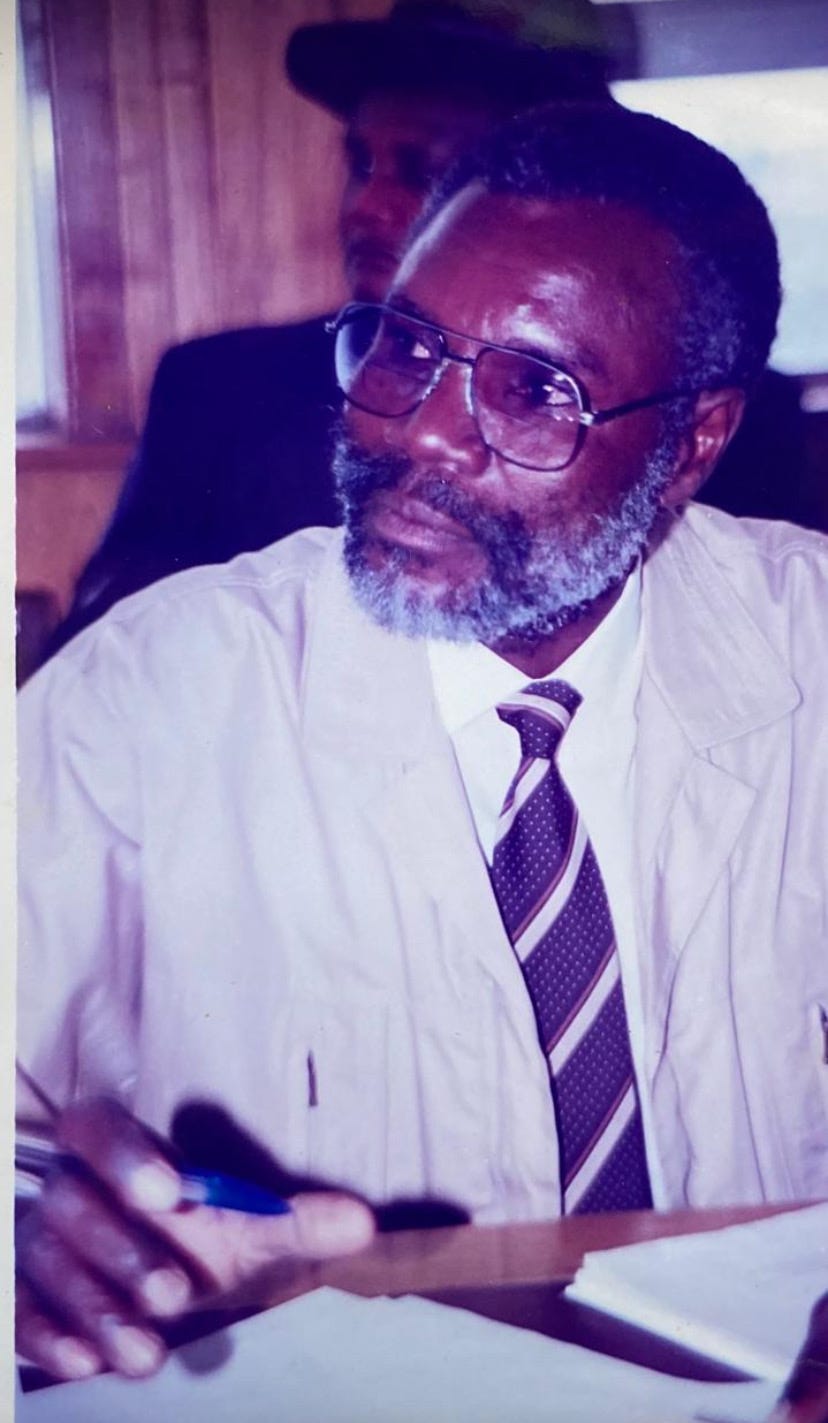
Kwaru, I want to hold your elbow in the corridor one more time. I want to feel the piano through the floor. I want to wash your feet. I want an ordinary day of you, and not the ceremony or the memory of you. A Tuesday. Your wife singing in the kitchen, the jacaranda dropping outside, the study with its six columns of books waiting to be dusted, you in your fur coat. You going to Winam while I walked beside you pretending I was not already memorizing the pace of you, the size of you, the irreplaceable fact of you moving through the world.
Twenty-six years since you first held me, Baba, and I am still incapable of filling the shape you left in my body. Your posture, patience, tiny eyes, kwach wag’e tinde Ochuka wuod Nyandori owadgi Risper. Your meticulous documentation and belief that love made legible is love made permanent. I have your ring. I wear, sometimes, the ghost of your suits.
I have a daughter who sits in my thinking chair and asks questions with the directness of someone who was sent here specifically to unnerve me, and when she does I recognize you in the composition of her curiosity; the same critique of approximating answers, the same hunger for the thing beneath the thing. She has your attention. I did not plan this. It came as all real inheritances come; without ceremony, simply present one morning when you look at someone you love and see, unmistakably, someone else you loved, and understand that this is not loss wearing a new face but love proving it was never only located in one body.
Duog itera bayo. Come back and take me not from this life, not from Awuor, not from the desk and or dana and the cold tea and the archive growing, but just for one morning. The jacaranda is dropping. I put a clover on my graduation portrait next to yours. I haven’t brought osimbo home yet. The PhD. Your wife says I already did by deed. I have learned, finally, how to peel the orange. Come and see.
#love #granddad #baba #anniversary #grief #memoir #precursor