
Somewhere Else
A Year Some More

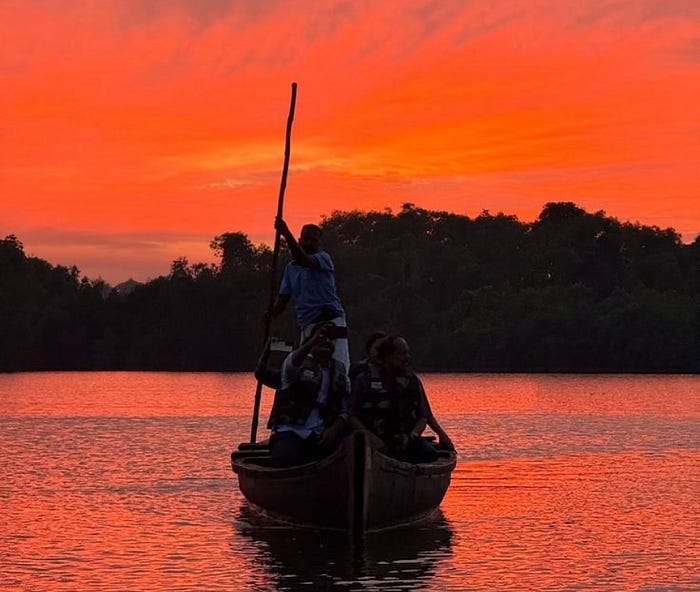
Displacement
I had the sense that my real life was happening somewhere very far away, happening without me and I didn’t know if I would ever find out where it was or become part of it.
2015
It is a Tuesday. Literally Tuesday, November 12th, at 2:34 PM, while I was sitting in the phlebotomy chair at Aga Khan Hospital watching my blood fill vials. A biological taxation. The phlebotomist — a woman named Mercy who’d been drawing my blood for three months and had perfected the art of small talk about everything except why I was there so often — was telling me about her daughter’s upcoming wedding.
“We’re doing it at Sawela Lodge,” she said, her hands steady as she labeled the fourth vial. “You know it? Out past Naivasha?”
I knew it. I’d been there once, in 2019, for a friend’s bachelor party. We’d drunk too much Tusker, told too many lies about our conquests and I’d had this absolute certainty that life was just beginning and everything good was still ahead, queued up as songs on a playlist I’d get to eventually.
“It’s beautiful there,” I said.
“Yes. My daughter is so excited. She’s 26. The perfect age, I think. Old enough to know what she wants, young enough to still believe in forever.”
It hit me. This vertiginous sense that my real life, the one I was supposed to be living, was happening at Sawela Lodge. Or in Uppsala where my sister in law was. Or in some alternate timeline where my bone marrow hadn’t decided to cosplay as a weapons manufacturer. My real life was out there, getting married at 26, believing in forever and not sitting in a phlebotomy chair at 33 watching proof of my body’s betrayal collect in glass tubes.
“All done,” Mercy said, pressing gauze to my arm. “You’ll get the results by Thursday.”
Thursday. Time still worked in a linear way. Thursday was guaranteed.
Almost-Lives
That night, I couldn’t sleep. It was not insomnia born of medication or anxiety. It was something more metaphysical. The sense that somewhere in Nairobi, in Kenya or in the world, there were versions of me living the lives I’d meant to live and I was stuck in this one, the wrong one, walking into the wrong apartment and everyone was too polite to tell me.
I got up, made tea. Kericho Gold. The way my grandmother taught me, with ginger and too much lemongrass. I sat on my balcony in Hurlingham. Below, a security guard was making his rounds, his torch beam cutting the night shapes into darkness. Somewhere, a baby was crying. Somewhere else, music was playing. Benga, old school. Abeka Jakoyugi. Orchestra Dumbe Dumbe. Or was it Goerge Ramogi? The same thing. A grievously nostalgia music even when you’re hearing it for the first time.
My phone buzzed. Akinyi: You awake?
Unfortunately.
Come over.
It’s 3 AM.
And? You’re dying, I’m insomniac and the night is young. Come over.
Akinyi lived in Lavington, fifteen minutes by Uber if you caught a driver who understood that some trips were existential emergencies. I got dressed. Jeans, t-shirt and a leather jacket I’d bought in 2018 when I still thought I’d live long enough to wear it out; and went.
3am Conversations
Her apartment always smelled of sandalwood and ambition. She opened the door in an oversized Sauti Sol t-shirt and glasses I’d never seen her wear.
“You look like a graduate student,” I said.
“You look like death warmed over,” she replied, which was honest enough to be loving. “Come in.”
We sat on her balcony. Nairobi seems to conduct all its most important conversations on balconies. Does elevation bring clarity? She poured us wine. Good wine, not the Kwa-Zulu stuff from the supermarket. Something French she’d been saving for an occasion that never came.
“Why are we drinking this now?” I asked.
“Because occasion-waiting is how people die with full wine racks. Talk to me. Why the 3 AM summons?”
I told her about Mercy’s daughter, Sawela Lodge and the feeling that my real life was happening somewhere else, to someone else and I was just here, a placeholder and stand-in, waiting for the real Ochuka to show up and take over.
She listened without interrupting, which is Akinyi’s superpower. The ability to hold space without filling it with her own noise.
When I finished, she said, “You know what I think?”
“Enlighten me.”
“I think everyone feels like that. Not the dying part…that’s yours, unfortunately. You know, the sense that real life is elsewhere? That’s universal. That’s the human condition dressed up in different costumes.”
“That’s depressing.”
“No, it’s liberating. If real life is always elsewhere, then it’s also always here. You’re not missing it. You’re in it. This — “ she gestured at the balcony, the wine and Nairobi spreading below us with a promise it couldn’t keep “ — this is the real life.”
“This is cancer and insomnia and existential dread.”
“Yes… and also drinks and conversations and the fact that when I texted you at 3 AM, you came. That’s real life too. Both things are true.”
Not Being Young
Wednesday morning, I met Chao for breakfast at Artcaffe. She was already there, attacking a croissant with a violence that suggested her day had started badly.
“Students?” I asked, sitting down.
“Students,” she confirmed. “I had a boy tell me that degrees is a Western construct designed to oppress African minds. I didn’t know whether to fail him or give him extra credit for creativity.”
I ordered black coffee and eggs I wouldn’t finish. Chao noticed but didn’t comment. This is what friendship is after a certain point, noticing everything, mentioning nothing.
“I’ve been thinking about innocence,” I said.
“Dangerous territory.”
“When did you stop being young?”
She put down her croissant. “Specific or philosophical?”
“Both.”
“Specifically: April 17th, 2019. I was walking home from school and a matatu hit a bodaboda right in front of me. The bodaboda guy died. Just… died. In the middle of Ngong Road at 4 PM on a Tuesday. And I remember thinking this is it. This is the thing they don’t tell you. Death doesn’t come dramatically. It comes at 4 PM on Ngong Road while you’re thinking about what to make for dinner.”
“Jesus, Chao.”
“You asked. Philosophically. I don’t think we stop being young at a single moment. I think innocence leaks out slowly, air from a tire, until one day you’re driving and you realize you’ve been running on fumes for years.”
The waiter brought my coffee. It was too hot but I drank it anyway. My charred nerve endings still worked. Some parts of my body hadn’t gotten the memo about the rebellion.
“I think I stopped being young,” I said, “the first time a doctor said ‘stage three.’ The way everyone looked at me after. Had I already become a ghost? Had my real life ended and this was just the epilogue?”
“But you’re still here.”
“Am I? Or am I just haunting my own life, watching it happen from the outside?”
Chao reached across the table and flicked my forehead.
“Ow. What was that for?”
“That’s for being melodramatic. You’re here. Annoyingly, persistently here. Your real life is happening to you, not without you.”
The Afternoon I Tried to Find Myself
Thursday, results day. My blast cell count was up enough that Dr. Riyat used that careful doctor voice that’s been trained to deliver bad news as information as neutral as weather.
“We’ll need to adjust the protocol,” he said.
Adjust the protocol. Was my body a recipe that just needed more salt and more time in the oven? I left the hospital and did something I hadn’t done in years. I took a matatu to town. A proper matatu with neon lights and a sound system that’s actively trying to perforate your eardrums. The one I got was called “Believer,” which felt either perfectly appropriate or cosmically mocking.
I sat in the back, squeezed between a woman with a baby and a man who may have been drinking since dawn and watched Nairobi scroll past the window. We went down Uhuru Highway, past all the monuments to optimism, Kenyatta International Conference Centre reaching for the sky. It still believed in upward mobility. The August 7th Memorial reminding me that tragedy is just another Tuesday.
The conductor was young, maybe 22, with a Kenyan hustle energy. Sharp, efficient and already tired. He was collecting fares and making change and shouting destinations all at once, a one-man symphony of survival.
“Boss, ni fifti,” he said to me.
I gave him a hundred. He made change from a roll of bills that could choke a hippo.
“Mzee unaenda wapi?” Where are you going?
Good question. Where was I going?
“Town,” I said, which wasn’t an answer.
“Town ni kubwa.” Town is big.
“Anywhere,” I said. “Just drop me anywhere.”
Longing as a Permanent Address
I got off at the Kenya National Archives. I don’t know why. Archives are where we store the past and I was feeling nostalgic for futures I hadn’t lived. The building looked tired. It had been holding onto history so long it had forgotten it was allowed to rest.
Inside it was cool and quiet. An institutional silence that makes you whisper even when there’s no one to disturb. There was an exhibition on Kenyan independence. Photographs from the 1960s, documents signed by people who believed they were building something permanent.
I stood in front of a photograph of Kenyatta at Parliament, his face filled with a certainty I couldn’t imagine possessing. The caption said it was taken in 1962. Before my parents were born. Before the idea of me was even possible.
“Powerful, isn’t it?” A voice beside me.
I turned. A woman, maybe 40, with gray starting to claim her temples. She had the look of someone who spent a lot of time in libraries and museums. A combination of purpose and patience.
“It is,” I agreed.
“He had no idea what was coming,” she said. “None of them did. They thought independence was the happy ending. Turned out it was just a new chapter.”
“Is anything ever an ending?”
“Death, I suppose.” She said it lightly, not knowing.
“Even that’s debatable,” I said. “You leave too much behind. Stories. Debts. Questions without answers.”
She looked at me more carefully then. “You’re young to be so philosophical about mortality.”
“Cancer makes you precocious.”
“Ah.” That syllable contained sympathy, recognition and the slight recoiling that healthy people do when confronted with the actively dying. “I’m sorry.”
“Don’t be. It’s teaching me things. How longing works.”
“How does longing work?”
I gestured at the photograph of old guards. “This. They longed for independence. Spent life reaching for it. Got it. Then spent the rest of his life longing for the version of Kenya they’d imagined, the one that didn’t quite match the one they got. Longing doesn’t end when you get what you want. It just finds new targets.”
“What do you long for?” she asked.
“To be somewhere else. Anywhere else. To have a life that isn’t constantly looking over its shoulder at death. To be young again in belief and believe in forever again, even for a minute.”
“That’s a lot of longing.”
“It’s all I’ve got.”
Ghostfriend
Friday evening, Bena called. “Boss, we need to talk.”
We met at K’Osewe in town. A legendary kienyeji place that’s been there so long it feels permanent, which is reassuring when everything else keeps changing. Ben was already there, had ordered for both of us; goat ribs and ugali and kunde that tasted like someone’s grandmother had blessed it.
“You look terrible,” he said.
“You’re the second person this week to tell me that.”
“Because it’s true. You’re losing weight. You look…” He searched for the word.
“Like I’m dying?”
“I was going to say haunted. Like you’re here but also somewhere else.”
I told him about the feeling. The phlebotomy chair and the sense that my real life was happening in a parallel universe where my bone marrow had better architectural plans.
Ben ate while I talked, methodically working through the ribs with the focus of someone who’s learned to let people say what they need to say.
When I finished, he wiped his hands on a wet wipe and said, “You remember Jim?”
“From uni? The guy who was going to be a pilot?”
“That one. I ran into him last month. He’s managing a hardware store in Rongai. Married, three kids, never got the pilot license. You know what he told me? He said he has dreams where he’s flying. Vivid dreams. And when he wakes up, is real life is up there in the cockpit and this life, the hardware store, wife and kids… is the dream. Or maybe the nightmare. He couldn’t decide.”
“What’s your point?”
“My point is… everyone feels like their real life is elsewhere. The healthy, dying, successful or struggling. We’re all convinced we took a wrong turn somewhere and ended up in the wrong life. But maybe this is the real life. Maybe the trick is to stop looking for it somewhere else.”
“That’s very Buddhist of you.”
“I went to a meditation retreat last month. Don’t make fun.”
“I’m not making fun. I’m jealous. You went to a meditation retreat. I went to get my blast cells counted.”
“You went to Kilifi with Nova. You published a book. You’re eating goat with me at K’Osewe on a Friday night. That’s real life too, Ochuka. Stop waiting for the real version to start. It already has.”
Sarit Centre
Saturday afternoon, I ended up at Sarit Centre. Not shopping. I can’t afford shopping. Existing in air-conditioned limbo where capitalism meets public space. I sat on a bench by the fountain and watched families walk past.
A couple in their twenties, holding hands, laughing at something on her phone. An old man with a cane, moving slowly but with purpose. A group of teenagers, loud and confident in their immortality. A woman my age, alone, eating ice cream with the concentration of someone who’s decided that today, ice cream is the answer.
I felt a wave of ennui so profound it was almost physical. A bone-deep weariness with the project of being human. The constant maintenance and pretending that anything matters when everything is temporary. A normalcy when nothing feels normal.
My phone buzzed. My sister in law Laverne, video calling from Sweden.
“Where are you?” she asked when I answered.
“The mall.”
“Which one?”
“Sarit.”
“Why do you look so sad?”
“Do I?”
“Ochuka. Talk to me.”
I told her. All of it. Mercy’s daughter and Sawela Lodge. National Archives and longing. Ben’s meditation retreat. The feeling that my real life was happening somewhere else and I’d been left behind with the consolation prize of this one.
She listened, her face on my screen small and far away but present in the way only a caring person can be. Both exasperated and loving.
“You want to know what I think?” she said when I finished.
“Always.”
“I think you’re grieving and not yet for yourself… for all the lives you won’t get to live. All the versions of you that won’t happen. That’s okay. That’s allowed. But dear — “ her voice got softer “ — the life you’re living now? It’s still a life and it counts and is real.”
“It doesn’t feel real.”
“I know. I think that’s depression talking. Or it’s existential something. Or maybe it’s just life in Nairobi at a mall. You’re there. You’re alive. You’re on video call with Nikki’s sister. You’re still here.”
After we hung up, I sat for a while longer, watching the fountain cycle through its programmed dance up, down… up, down. The same pattern repeated infinitely. That’s what fountains do.
Post-Youth Adjustment
Sunday morning, I went to church. I’m not even religious. I have a complicated relationship with God that mostly involves accusatory questions. My grandmother asked and when you’re dying, you stop refusing your mother’s humble requests.
The service was at a AIC church in Milimani, one of those congregations where everyone’s slightly too well-dressed and the pastor has clearly studied American megachurches. He was preaching about purpose.
“God has a plan for your life!” he announced, his voice amplified to godlike proportions. “You are here for a reason! You have a destiny!”
I wanted to raise my hand and ask him if my destiny is to die at 33? What if the plan includes acute myeloid leukemia and blast cells and watching my friends get married and have children while I collect vials of blood for medical purposes? Is that still a plan worth celebrating?
I didn’t. I sat quietly next to dana, who was singing along to the praise songs with a fervor that suggested she believed every word. After the service, she introduced me to various church ladies who all said the same thing: “God will heal you. Have faith.”
Faith. Was faith a currency you could exchange for health? Believing hard enough could convince your bone marrow to stop its rebellion?
Walking to the car, dana said, “You don’t have to come next week if you don’t want to.”
“It’s fine, ma.”
“No, it’s not. I can see it’s not. You have that look.”
“What look?”
“The look you had when you were 15 and you’d stopped believing in anything but your own skepticism. The world had disappointed you and you’d decided to return the favor.”
She was right. 2005, I’d lost my innocence to reality and the gap between what school promised and what it delivered, what adults said and what they did, l the dreams we’re sold and the lives we’re given. I’d adjusted, reluctantly, to the fact that life wasn’t a story with a moral. It was a series of random events we tried to narrate into meaning.
Now, at 33, I was going through another adjustment. From sick to dying to thriving. From future tense to conditional. From “when I’m older” to “if I make it.”
“I’m tired, dana,” I said. “I’m just really tired of adjusting, recalibrating my expectations down and learning to want less because wanting more feels irresponsible.”
She stopped walking. Put her hand on my cheek like I was still 5 and she could fix anything with touch.
“I know,” she said. “I know, doki. As long as you’re here, you get to want. You get to hope. You get to be disappointed and angry and tired. You get to have all of it.”
Life Is Here (An Epilogue That Isn’t)
Sunday night, back at my apartment. I made dinner Nothing fancy. Pasta with that sauce from Carrefour and a salad that was mostly cucumber because I’d forgotten to buy other vegetables. I ate on my balcony, watching Nairobi do its thing.
My phone dinged. Chao had sent a photo of her at a bar in Westlands, surrounded by friends, everyone laughing. The caption: Wish you were here.
I typed back: Me too.
The truth was more complicated. Part of me wished I was there healthy, normal, capable of drinking and laughing without calculating the impact on my liver function. Another part of me was exactly where I needed to be; on my balcony, with my mediocre pasta, watching the security guard make his rounds.
This was my real life. Not the one I’d planned or the one I longed for or the one happening at Maldives or in Uppsala or in some parallel universe where my body hadn’t betrayed me.
This one. Right here. With its phlebotomy appointments and blast cell counts and 3 AM conversations and Ben’s nyama choma and my a Laverne ‘s video calls and dana’s church and Chao’s wine and Wangui’s croissant violence.
Real life wasn’t somewhere else. It was here. It had always been here. I just hadn’t recognized it because I was too busy looking for the version I thought I deserved where I was healthy and young and believed in forever. That life was never mine to live. This one was.
I had the sense that my real life was happening somewhere very far away, happening without me. I was wrong.
My real life was happening right here, in Nairobi, at 9:47 PM on a Sunday, with lukewarm pasta and a view of security lights and the knowledge that tomorrow I’d wake up and do it all again. The adjusting, longing, grief and my tiny rebellions against mortality.