
The Grove
An Essay in Bark and Breath

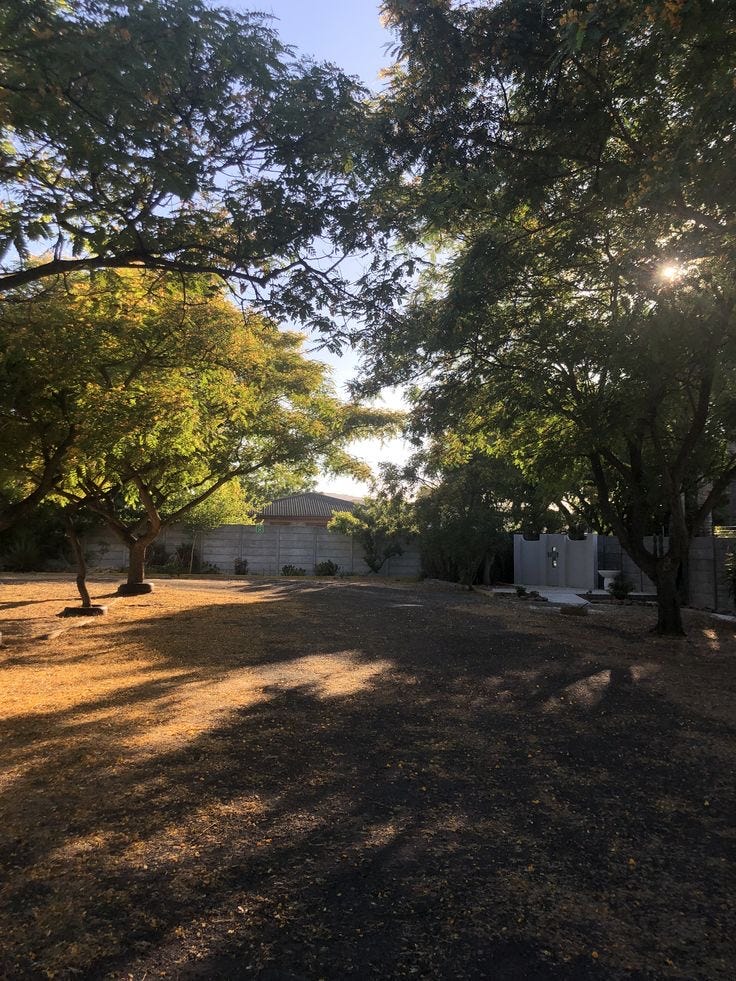
Whatever the conditions, where a tree sprouts is where it lives its life. That is its first being, burden and inheritance. I think of this often when digging in the compound garden at dawn, ankle-deep in dew; when stirring millet porridge in the blackened pot under the sooty kitchen roof; when pausing mid-river to rinse my hands and feel how the cold water remembers more than I do.
Where you sprout; whether in stony soil or soft, whether in shadow or wide, unmerciful sun, is where you must grow. And grow still.
The tree teaches us this by being. Out of this enforced stillness and long-suffering rootedness, a different form of intelligence emerges. A patience that is not passive. A waiting that is not idle. A wisdom soaked into bark, leaf and lichen spoken the gentle shelter of canopies and the time it takes for one season to bow out of the way for another.
As I have aged, my bark has grown shaggy. Knots have formed where my limbs were once supple. There are days my joints sound like broken branches beneath the feet of memory. I’ve found brittle twigs in my hair, and once, a small spider nestled behind my ear like a secret trying to hatch. My skin too, darkened, folded and thickened like the jacaranda trunk by the cattle trough, which cracked during the long drought of '99, but never fell.
I am not embarrassed by this bark. It is a story I wear. Sometimes, when Awuor was still young enough to press her palm to my face to check my fever, she’d say, "Baba, you’re turning into one of your trees." I’d tell her, "Yes. Maybe I was always meant to."
We grew up in a land where trees outlived everyone; uncles, teachers and even the whispering ghosts of the colonial schoolmasters. Trees bore witness to generations of quarrels, marriages, healings and mimicked reconciliation during funerals.
At dala, there are trees that know names no longer remembered by the living. They watched my grandfather pass the initiation rites with an aching stomach and a bleeding ear. Trees beneath which my grandmother gave birth, squatting like a woman possessed by something holy and unforgiving.
Sometimes when I visit home, home as in the ancestral plot and not the rented place in town, I go sit under the keyo tree behind the granary. It was once tall, crooked and proud. Now it leans, its bark peeling in strips like old political posters. Still, it gives shade. Birds still come. Children still dare each other to climb. It has not asked to be anything more than what it is.
That is what I mean by wisdom.
Yesterday, in a dream, or maybe a memory, I visited dol. I climbed to take food for my uncle who was planting uphill.
It was hot. Twenty-five degrees but beneath those elders, it was cool. A coolness from an unbending matriarch who teaches that slowness is not failure, and stillness is not absence.
Old people walked there. The frail and bent. Children too, eyes wide, dragging sticks like sacred staffs. One at a time, we crossed a suspension bridge that trembled under each heartbeat. A woman leaned into her cane, her bones speaking directly to the cedar beside her. A man with a beard like river mist nodded toward the firs, as if greeting relatives from another lifetime. No one hurried. No one needed to. The trees were in no rush to be understood.
There is no word for forest that does not also mean refuge. Thim, the wild bush, is also the place where lovers hide, girls go to gather herbs for their mothers and boys learn to track. It is the place where, during the dark days of ‘92 politics, tribal clash in Sondu and cattle rustling, old men buried their radios and women hid dried maize in hollows when police raided for silence and violence.
Maybe we give names to such places to protect them. Maybe a grove needs no name when it can give so much silence.
I often wonder what will I become when I can no longer move?
When my legs no longer obey and my back bends from wear? That, too, will be part of my gift to the world. A new stillness. A new listening.
Old men who can no longer walk are carried to the shade each morning and left with a pot of water, a gourd of sour milk and their thoughts. They don't ask for radios. They don't need updates. They watch the chickens fight or comment on the direction of wind, the mood of goats and the shape of clouds. Their conversations with the day are enough. Their being is enough.
I want to age like that. Placed beneath a fig tree with a stool carved by a nephew while listening to the wind translate my failures into something useful. To be visited by my daughter, now grown and tender, with her own aches and hear her footsteps before I see her. To know, without turning, that she is coming. She still adores me.
Sometimes caregiving is placing a basin beside someone without them asking. Adjusting a cushion. Wiping the sweat from a forehead too proud to request help. It is known. The way trees bend toward the sun, wordlessly and patiently.
Sometimes love is the ability to hold space and become shade.
My uncle tends to his mother, even when she no longer remembers his name. Awuor pressed a cold cloth to my head one night, sitting, watching the mosquito net billow into a veil between here and elsewhere.
Trees know this. Trees give because they have no other way to be.
Where a tree sprouts is where it must live. How it lives is the art.
I am learning, still, how to live with less memory, bark that aches when it rains, more gratitude for wind and reverence for those who stayed rooted even when the ground split.
There are days I want to move, run and dance again and there are days when I simply want to stand and be a presence in someone’s periphery. A shadow on the wall. A body at rest, offering nothing but the fact of still being here.